ilikefandomsmorethanpeople:

gravityofstars:

shedoesnotcomprehend:

One of the most bizarrely cool people I’ve ever met was an oral surgeon who treated me after a ridiculous accident (that’s another story), Dr. Z.


Dr. Z. was, easily, the best and most competent doctor or dentist I’ve ever encountered – and after that accident, I encountered quite a number. He came stunningly highly recommended, had an excellent record, and the most calming bedside manner I’ve ever seen.

That last wasn’t the sweet gentle caretaking sort of manner, which some nurses have but you wouldn’t expect to see in a surgeon. No; when Dr. Z. told me that one of my broken molars was too badly damaged to save, and I (being seventeen and still moderately in shock) broke down crying, he stared at me incredulously and said, in a tone of utter bemusement, “But – I am very good.”

I stopped crying on the spot. In the last twenty-four hours or so of one doctor after another, no one had said anything that reassuring to me. He clearly just knew his own competence so well that the idea of someone being scared anyway was literally incomprehensible to him. What more could I possibly ask for?

(He was right. The procedure was very extended, because the tooth that needed to be removed was in bits, but there was zero pain at any point. And, as he promised, my teeth were so close together that they shifted to fill the gap to where there genuinely is none anymore, it’s just a little easier to floss on that side.)


But Dr. Z.’s insane competence wasn’t just limited to oral surgery.

When I met Dr. Z., he, like most doctors I’ve had, asked me if I was in college, and where, and what I was studying. When I say “math,” most doctors respond with “oh, wow, good for you” or possibly “what do you want to do with that after college?”

Dr. Z. wanted to know what kind of math.

I gave him the thirty-second layman’s summary that I give people who are foolish enough to ask that. He responded with “oh, you mean–” and the correct technical terms. I confirmed that was indeed what I meant (and keep in mind, this was upper-division college math, you don’t take this unless you’re a math major). He asked cogent follow-up questions, and there ensued ten or so minutes of what I’d call “small talk” except for how it was an intensely technical mathematical discussion.

He didn’t, as far as I can tell, have any kind of formal math background. He just … knew stuff.


I was a competitive fencer at this point in time, so when he asked if I had any questions about the surgery that would be necessary, I asked him if I’d be okay to fence while I had my jaw wired shut, or if it would interfere with breathing.

“Fencing?” he said.

“Yes,” I said, “like swordfighting,” because this is another conversation I got to have a lot. (People assume they’ve misheard you, or occasionally they think you mean building fences.)

“Which weapon?”

“Uh. Foil.”

“No, it won’t be safe,” and he went off into an explanation of why.

Turns out, he was also a serious fencer – and, when I mentioned my fencing coach, an old friend of his. (I asked my fencing coach later, and, oh yes, Dr. Z., a good friend of mine, excellent fencer.) (My coach was French. Dr. Z. was Israeli. I never saw Dr. Z. around the club or anything. I have no idea how they knew each other.)


So this was weird enough that later, when I was home, I looked Dr. Z. up on Yelp. His reviews were stellar, of course, but that wasn’t the weird thing.

The weird thing was that the reviews were full of people – professionals in lots of different fields – saying the same thing: I went to Dr. Z. for oral surgery, and he asked me about what I did, and it turned out he knew all about my field and had a competent and educated discussion with me about the obscure technical details of such-and-such.

All sorts of different fields, saying this. Lawyers. Businessmen. Musicians.

As far as I can tell, it’s not that I just happened to be pursuing the two fields he had a serious amateur interest in – he just seemed to be extremely good at literally everything.

I have no explanation for this. Possibly he sold his soul to the devil.

He did a damn good job on my surgery.

He’s a 900 year old vampire. No other explanation.

Yeah my immediate though was immortal

Synetic Theater’s Unforgettable Watery Worlds

thepookah:

col-brightside:

synetic-on-the-move:

In 2013, Arlington-based Synetic Theater took their signature cinematic style to a new level when they flooded the stage with water for a production of The Tempest.

The physical theater company, well known for their wordless productions of Shakespeare plays, had previously created a water stage for their 2010 production of King Arthur. Known for their creative use of mixed media, Synetic Theater utilized the water to add an extra layer of magical realism to that production.

image

The Tempest was to be the 9th installment of  Synetic’s popular Wordless Shakespeare series and Founding Artistic Director Paata Tsikurishvili was inspired to use a water stage by the way in which water is closely tied to the plot.

“The exiled Prospero is sent to an island, surrounded and inundated by water,” Tsikurshvili said. “His power and magic grows from it, and even the inciting action is created by water when Prospero uses a storm to bring his enemies to him.”

Water is a versatile theatrical element, conveying a variety of emotions and feelings. It can be at once dramatic, comical, magical, and lyrical. Additionally, the hypnotic combination of water and physical theater captivated audiences’ imaginations in a totally new way.

image

Once Tsikurishvili decided on the watery world his Tempest would be set in, he tapped Synetic’s Resident Stage Manager Marley Giggey and Technical Director Phil Charlwood to figure out the logistics of getting water into a pool onstage. “It was the strangest combination of terror and excitement I have ever experienced,” Giggey said of her first meeting about working on a water stage.

Technical Director Phil Charlwood had worked on King Arthur three years prior, and this time he strove to improve circumstances for the actors. The biggest challenge was keeping the water at a comfortable temperature. By using large heaters, Charlwood was able to keep the water warm during performances. 

Charlwood also used his innovative design and building techniques to create one of the most compelling elements of the production, a piano fountain that served as an important piece of the set.

image

Filling the pools and keeping the water clean and safe fell to Giggey. “The water came from several hoses running from two sinks in the laundry room backstage and in the lobby,” she said. “The drain was a series of PVC pipes that connected together and went to a hose. We would bring out all the pipes and connect them – going out the loading dock door and leading to a floor drain in the parking garage that could accommodate all that water!  Before each performance I would do a half drain and fill.

“We would drain about half of the pool and then fill it back up to show levels with hot water.  On Fridays and Sundays we did a total drain of the pool and a very through scrub and clean. Then we let it dry for at least 12 hours before refilling.  It was a time consuming process, but keeping the pool safe and clean was key.”

image

Once the water was on stage, Giggey was faced with more challenges. The stage lights made it difficult for the actors to consistently see the spike marks. This problem was solved with a grid system that allowed the actors to line themselves up with the left and downstage points.

The actors movement in the pool created a lot of splashing into the audience. Synetic offered branded ponchos to patrons in this “splash zone” and those seats became the most popular for the production.

image

Lighting designer Andrew Griffin enjoyed working with water and overcoming the challenge the water gave him in designing a light plot for the show.

“The light would reflect and refract because the water floor was reminiscent of a mirror,” he said. Griffin used several low-angled sidelights to exploit the angles of light that would scrape across the floor, rendering less of a reflected impact on the architecture of the space. This effect made it seem as though the water was dancing along with the characters. “Through a lot of careful planning, we created some pretty great effects,” said Griffin.

image

When working with water, there was also the question of mold and mildew – particularly concerning costumes. The costumes were all treated with camp spray to help waterproof them. “Cleaning the costumes was very tricky,” Giggey said.  “They had to be thoroughly washed so we turned the back room of the theater into a ‘dry room’ with fans blowing from all directions and drip buckets to catch all the water.  The last thing any actor wanted was to put on damp costumes or shoes when they came in the next day.”

image

Working with water required Synetic’s creative team to master a free-flowing element that is not easy to control consistently. Synetic was able to overcome many obstacles and use the water to their advantage with the help of various theatrical elements, all while taking the necessary steps to protect their performers.

The hours of maintenance required to keep the pool clean and functional and the additional challenges of working with water in a theatrical setting paid off. “It was a moment that was so immersive and dramatic that it was difficult to believe it was happening live in front of you,” Giggey said. “The energy in the theater as the actors were jumping, spinning, and splashing was electric!”

Overall, the creative team, crew, actors and audiences appreciated and valued this rare experience. The professionalism, ingenuity, and talent of the production crew, actors, and artistic team helped to make The Tempest Synetic’s highest grossing show to date.

image

I love that I get to work with these folks. 

I love that this post keeps coming back.

My god

nerdgasrnz:

jedijenkins:

airagorncharda:

petralemaitre:

derryderrydown:

bomberqueen17:

bedbugsbiting:

My face is having uncontrollable spasms. Great. It hurts really, really, really bad.

I think part of why I have trouble explaining pain to the doctor is when they ask about the pain scale I always think “Well, if someone threw me down a flight of stairs right now or punched me a few times, it would definitely hurt a lot more” so I end up saying a low number. I was reading an article that said that “10” is the most commonly reported number and that is baffling to me. When I woke up from surgery with an 8" incision in my body and I could hardly even speak, I was in the most horrific pain of my life but I said “6” because I thought “Well, if you hit me in the stomach, it would be worse.”

I searched and searched for the post this graphic was from, and the OP deactivated, but I kept the graphic, because my BFF does the same thing, uses her imagination to come up with the worst pain she can imagine and pegs her “10″ there, and so is like, well, I’m conscious, so this must be a 5, and then the doctors don’t take her seriously. (And she then does things like driving herself to the hospital while in the process of giving birth. Probably should have called an ambulance for that one!)

So I found this and sent it to her. Because this is what they want to know: how badly is this pain affecting you? Not on a scale of “nothing” to “how I’d imagine it’d feel if bears were eating my still-living guts while I was on fire”. 

I hate reposting stuff, but I’ll never find that post again and OP is deactivated, so, here’s a repost. I can delete this later, i just wanted to get it to you and I can’t embed images in a chat or an ask. 

This is possibly why it took several weeks to diagnose my fractured spine.

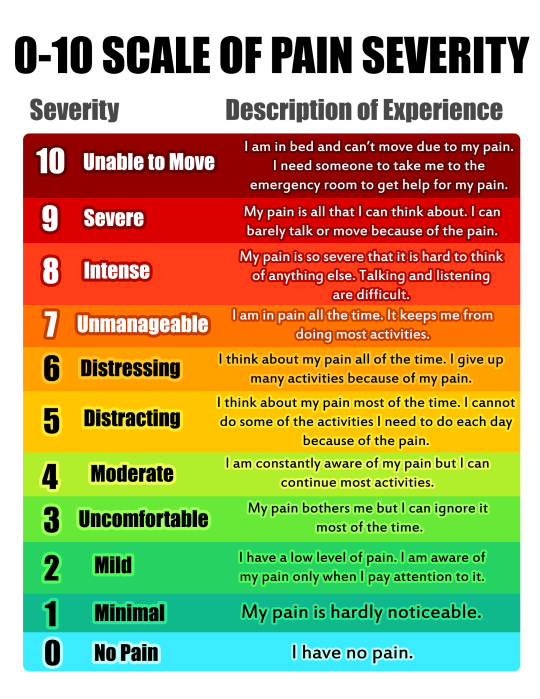
Pain Scale transcription:

10 – I am in bed and I can’t move due to my pain. I need someone to take me to the emergency room because of my pain.

9 – My pain is all that I can think about. I can barely move or talk because of my pain.

8 – My pain is so severe that it is difficult to think of anything else. Talking and listening are difficult.

7 – I am in pain all the time. It keeps me from doing most activities.

6 – I think about my pain all of the time. I give up many activities because of my pain.

5 – I think about my pain most of the time. I cannot do some of the activities I need to do each day because of the pain.

4 – I am constantly aware of my pain but can continue most activities.

3 – My pain bothers me but I can ignore it most of the time.

2 – I have a low level of pain. I am aware of my pain only when I pay attention to it.

1 – My pain is hardly noticeable.

0 – I have no pain.

It’s also really important to get this kind of scale to people who have chronic pain, because chronic pain drastically lowers your perception of how “bad” any kind of pain actually is, and yet something like this pain scale is extremely user friendly. 

For example, if someone asked me how much pain I’m in at any given time, I’d say hardly any, and yet I’m apparently at a chronic 2.5, and it only goes up from there depending on the day. 

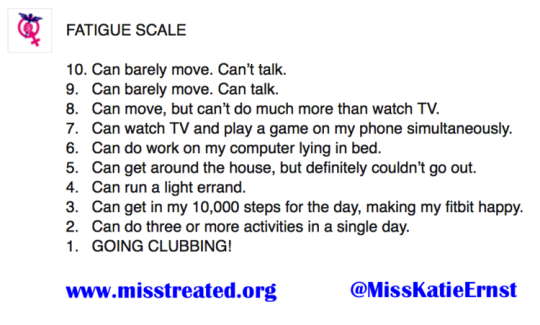
There’s also a similarly useful “Fatigue Scale”

I haven’t been below a 5 on this scale for 4 years 

Here’s the fatigue scale